


When Tricia Rausch, RN, BSN, walks down the hall at AdventHealth Shawnee Mission, she passes the room where her life changed forever.
It’s the same hallway she once couldn’t bear to enter. Now, she steps into it every day with purpose. Because this is where she held her son, Andrew, and in many ways, it’s where she still does.
“This work is a partnership with him,” she says softly. “I’m here – and he’s pushing me along.”
Today, Rausch serves as the Perinatal Bereavement and Postpartum Emotional Support Coordinator, a role born out of personal heartbreak and transformed into a mission of healing for others. For families facing the unimaginable: infant loss, pregnancy loss, or life-limiting diagnoses, Rausch is a steady, compassionate guide.
But long before she was a source of comfort for so many others, Rausch was a mother on the other side of the door.
A Journey No Parent Plans
In 2007, Rausch was pregnant with her fourth child. The pregnancy was healthy, uneventful; “a great pregnancy,” she remembers. At 38 and a half weeks, she came to the hospital thinking labor had begun.
Instead, she heard the words no parent should ever have to hear: “I’m sorry. There’s no heartbeat.”
Their son, Andrew, was born still; 8 pounds, 3 ounces, with a head full of dark hair. “He was perfect. Beautiful,” Rausch recalls. “And then came the question we never imagined: Now what?”
What followed was a long, lonely road of grief, healing and spiritual wrestling, for her, her husband and their three living children.
“You question everything,” she says. “Did I do something wrong? Did I move too much? Did God not think I needed this baby as much as I did?”
In the midst of that pain, however, was one steadying force: the compassionate care Rausch and her family received from the hospital team that day. It was, in her words, “a light on the darkest day of our lives.”
From Patient to Caregiver
A year after Andrew’s death, Rausch felt called to return to work, and she knew exactly where she wanted to be. “I wanted to be part of the team that took care of us,” she says. “I wanted to give back.”
She joined the hospital as a nurse, and word of her story spread quickly. “People knew who I was before I started,” she says. Soon, when a family experienced loss, Rausch was the one they called.
From there, a role began to take shape; first informal, then part-time and eventually full-time. She began by standardizing care so every family received consistent keepsakes: photos, footprints, memory boxes. “It broke my heart that not every family had those,” she says. “I didn’t want to share (that I had received) mine, because I felt guilty. That needed to change.”
What started as one mom’s desire to ease others’ pain grew into a comprehensive, donor-supported bereavement program that’s become a model for hospitals nationwide.
A Ministry of Memory-Making
Today, Rausch’s role spans far beyond bedside care. She helps families navigate every aspect of the loss experience, from the hospital stay to memory-making to funeral arrangements.
Each situation is unique. Some families arrive at triage without warning. Others have received life-limiting diagnoses during pregnancy and are planning for precious minutes or hours with their baby. Some want baptisms. Others need sibling support. Many don’t know what they need yet ... but Rausch does.
She facilitates everything from handprints and professional photography to stuffed animals and beaded bracelets made by siblings. With the help of donor-funded resources, she’s able to offer keepsakes like memory boxes, grief books and even plates hand-painted with each baby’s footprints by Mamie’s Poppy Plates.
She helps with funeral home coordination so no parent has to leave their child alone to make arrangements, a pain her own husband experienced.
And she follows up, personally, with families after they go home. “Grief doesn’t end when you leave the hospital,” she says. “And you don’t always remember what people told you when you were in shock. So I reach out again. I ask what they need now.”
A Community of Remembrance
The care doesn’t end there. Each year, AdventHealth hosts two deeply moving events: a Butterfly Release in October and a Candle Lighting Ceremony in December. Both are open to the community.
Rausch calls them some of her proudest moments.
“I stand up front and read every baby’s name,” she says. “And I can picture each one. To see these families still standing, still walking, still honoring their babies – that's powerful.”
These events, like so many parts of the program, are made possible through support from AdventHealth Foundation Kansas City donors. That generosity funds the memory boxes, the grief resources, the craft supplies, the books for siblings, and the Caring Cradle – a cooling cot that allows families to spend more time with their baby.
Currently, the hospital has one Caring Cradle. Rausch dreams of having more, not just at Shawnee Mission, but at AdventHealth South Overland Park and AdventHealth Ottawa, too.
“We want every family, no matter where they deliver, to have access to the same level of compassionate care,” she says.
A Heart in the Garden
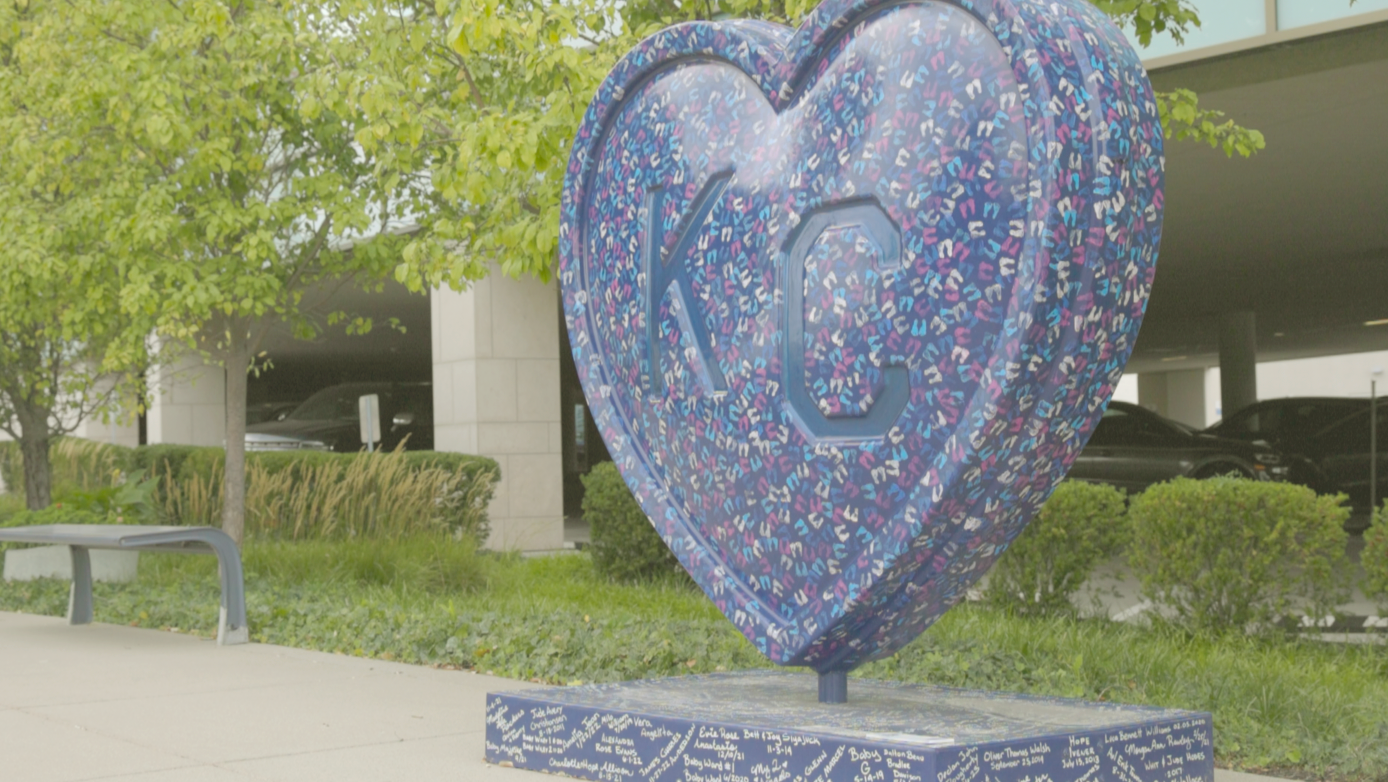
Outside the birth center sits a large, painted heart sculpture. Families often pull over to take photos with it, especially those who return to welcome a “rainbow baby” after loss.
The sculpture was created by a fellow loss mom, with names submitted by families. Many of those names belonged to babies delivered at AdventHealth. Rausch advocated to bring the heart to Shawnee Mission, and thanks to a donor family, it now lives where it belongs.
“It’s beautiful. It’s accessible. And it means everything to our families,” she says. “They come back with their rainbow babies and take pictures with the heart. It’s still part of their story.”
"You're Never Alone"
Rausch doesn’t offer families platitudes. She offers presence. She sits with them in silence. She helps them speak the things they’re afraid to say out loud.
She reminds them: This is not your fault.
She reassures them: Your baby knew how much you loved them.
She reflects: You may go on to have more children. You may come to a place of acceptance. But the pain is always there, and that’s okay.
“If I could tell every grieving parent one thing,” she says, “it’s that you’re never alone. Your baby is always with you. And so are we.”
Her work is, in her words, a calling. A ministry. A partnership with Andrew.
And for every family who walks through this sacred program, Rausch is proof that grief and healing can live side by side.
How You Can Help
If you were moved by Rausch’s story, consider supporting the Perinatal Bereavement Program through AdventHealth Kansas City Foundation. Donations fund everything from keepsake boxes and sibling books to the Caring Cradle that gives families more time with their babies.
Every parent deserves to feel seen, supported and surrounded by love – especially in life’s most heartbreaking moments.