“This Is Where I Hold Him”: How One Mother's Grief Became a Lifeline for Hundreds of Families

When Tricia Rausch, RN, BSN, walks down the hall at AdventHealth Shawnee Mission, she passes the room where her life changed forever.

It’s the same hallway she once couldn’t bear to enter. Now, she steps into it every day with purpose. Because this is where she held her son, Andrew, and in many ways, it’s where she still does.

“This work is a partnership with him,” she says softly. “I’m here – and he’s pushing me along.”

Today, Rausch serves as the Perinatal Bereavement and Postpartum Emotional Support Coordinator, a role born out of personal heartbreak and transformed into a mission of healing for others. For families facing the unimaginable: infant loss, pregnancy loss, or life-limiting diagnoses, Rausch is a steady, compassionate guide.

But long before she was a source of comfort for so many others, Rausch was a mother on the other side of the door.

A Journey No Parent Plans
In 2007, Rausch was pregnant with her fourth child. The pregnancy was healthy, uneventful; “a great pregnancy,” she remembers. At 38 and a half weeks, she came to the hospital thinking labor had begun.

Instead, she heard the words no parent should ever have to hear: “I’m sorry. There’s no heartbeat.”

Their son, Andrew, was born still; 8 pounds, 3 ounces, with a head full of dark hair. “He was perfect. Beautiful,” Rausch recalls. “And then came the question we never imagined: Now what?”

What followed was a long, lonely road of grief, healing and spiritual wrestling, for her, her husband and their three living children.

“You question everything,” she says. “Did I do something wrong? Did I move too much? Did God not think I needed this baby as much as I did?”

In the midst of that pain, however, was one steadying force: the compassionate care Rausch and her family received from the hospital team that day. It was, in her words, “a light on the darkest day of our lives.”

From Patient to Caregiver
A year after Andrew’s death, Rausch felt called to return to work, and she knew exactly where she wanted to be. “I wanted to be part of the team that took care of us,” she says. “I wanted to give back.”

She joined the hospital as a nurse, and word of her story spread quickly. “People knew who I was before I started,” she says. Soon, when a family experienced loss, Rausch was the one they called.

From there, a role began to take shape; first informal, then part-time and eventually full-time. She began by standardizing care so every family received consistent keepsakes: photos, footprints, memory boxes. “It broke my heart that not every family had those,” she says. “I didn’t want to share (that I had received) mine, because I felt guilty. That needed to change.”

What started as one mom’s desire to ease others’ pain grew into a comprehensive, donor-supported bereavement program that’s become a model for hospitals nationwide.

A Ministry of Memory-Making
Today, Rausch’s role spans far beyond bedside care. She helps families navigate every aspect of the loss experience, from the hospital stay to memory-making to funeral arrangements.

Each situation is unique. Some families arrive at triage without warning. Others have received life-limiting diagnoses during pregnancy and are planning for precious minutes or hours with their baby. Some want baptisms. Others need sibling support. Many don’t know what they need yet ... but Rausch does.

She facilitates everything from handprints and professional photography to stuffed animals and beaded bracelets made by siblings. With the help of donor-funded resources, she’s able to offer keepsakes like memory boxes, grief books and even plates hand-painted with each baby’s footprints by Mamie’s Poppy Plates.

She helps with funeral home coordination so no parent has to leave their child alone to make arrangements, a pain her own husband experienced.

And she follows up, personally, with families after they go home. “Grief doesn’t end when you leave the hospital,” she says. “And you don’t always remember what people told you when you were in shock. So I reach out again. I ask what they need now.”

A Community of Remembrance
The care doesn’t end there. Each year, AdventHealth hosts two deeply moving events: a Butterfly Release in October and a Candle Lighting Ceremony in December. Both are open to the community.

Rausch calls them some of her proudest moments.

“I stand up front and read every baby’s name,” she says. “And I can picture each one. To see these families still standing, still walking, still honoring their babies – that's powerful.”

These events, like so many parts of the program, are made possible through support from AdventHealth Foundation Kansas City donors. That generosity funds the memory boxes, the grief resources, the craft supplies, the books for siblings, and the Caring Cradle – a cooling cot that allows families to spend more time with their baby.

Currently, the hospital has one Caring Cradle. Rausch dreams of having more, not just at Shawnee Mission, but at AdventHealth South Overland Park and AdventHealth Ottawa, too.

“We want every family, no matter where they deliver, to have access to the same level of compassionate care,” she says.
A Heart in the Garden
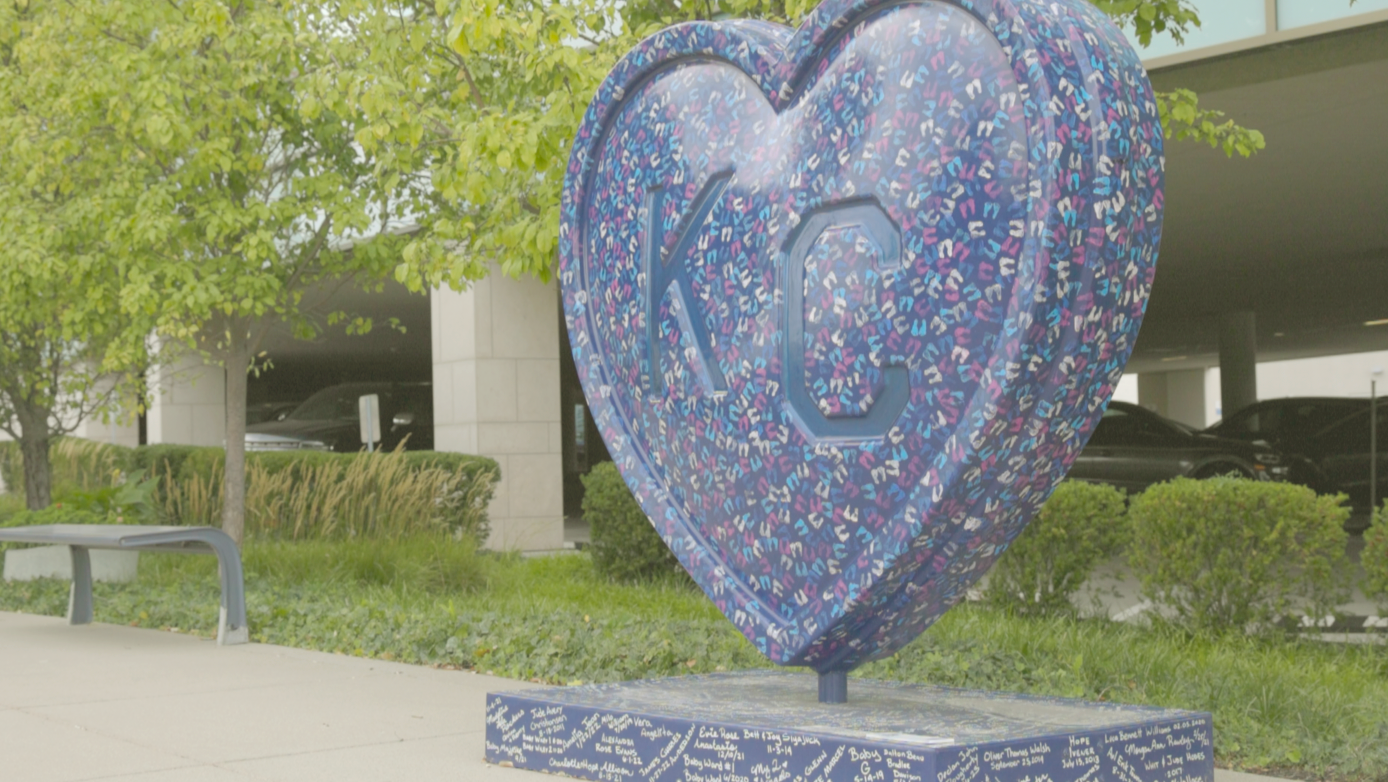
Outside the birth center sits a large, painted heart sculpture. Families often pull over to take photos with it, especially those who return to welcome a “rainbow baby” after loss.

The sculpture was created by a fellow loss mom, with names submitted by families. Many of those names belonged to babies delivered at AdventHealth. Rausch advocated to bring the heart to Shawnee Mission, and thanks to a donor family, it now lives where it belongs.

“It’s beautiful. It’s accessible. And it means everything to our families,” she says. “They come back with their rainbow babies and take pictures with the heart. It’s still part of their story.”

"You're Never Alone"
Rausch doesn’t offer families platitudes. She offers presence. She sits with them in silence. She helps them speak the things they’re afraid to say out loud.

She reminds them: This is not your fault.

She reassures them: Your baby knew how much you loved them.

She reflects: You may go on to have more children. You may come to a place of acceptance. But the pain is always there, and that’s okay.

“If I could tell every grieving parent one thing,” she says, “it’s that you’re never alone. Your baby is always with you. And so are we.”

Her work is, in her words, a calling. A ministry. A partnership with Andrew.

And for every family who walks through this sacred program, Rausch is proof that grief and healing can live side by side.

How You Can Help
If you were moved by Rausch’s story, consider supporting the Perinatal Bereavement Program through AdventHealth Kansas City Foundation. Donations fund everything from keepsake boxes and sibling books to the Caring Cradle that gives families more time with their babies.

Every parent deserves to feel seen, supported and surrounded by love – especially in life’s most heartbreaking moments.

A Planned Gift with Purpose: Honoring the Spirit of Care 

For years, Rev. Robert LaPietra walked the halls of AdventHealth Shawnee Mission as a chaplain, comforting patients in crisis and guiding staff through moments of fatigue, fear, and faith. His wife, Kristy, spent nearly as much time there, but on the inside of the hospital bed instead of beside it. 

 “We’ve been part of this place for a long time,” Kristy says. “As a patient, a caregiver, a chaplain, a couple. It’s in our story.” 

 That story, rooted in spiritual calling, shaped by hardship and transformed by love, is what led the LaPietras to include AdventHealth Kansas City Foundation in their estate plan. Their planned gift will be directed to the Spiritual Wellness department, supporting hospital chaplains and caregivers in ways that reflect Robert’s own journey. 

But this is more than a financial contribution. It’s a legacy of compassion. 

“It isn’t that we have to,” Kristy says. “It’s that we get to.” 

A Path Forged in Faith (and Fatigue) 

Robert didn’t plan to become a hospital chaplain. In fact, when a friend suggested he apply to AdventHealth’s Clinical Pastoral Education (CPE) internship, he had never even heard of the program. 

“I didn’t have the data, but I had the calling,” he says. “It was a knowing – something spiritual. I was supposed to be there.” 

And so, he entered the CPE program: a rigorous two-year spiritual and clinical training that required didactic coursework, overnight on-call shifts, and hands-on pastoral care across every hospital unit. He paid tuition, bought books, and worked for free. Kristy was recovering from back surgery. They had little income and leaned on retirement savings. 

“It was hard,” he recalls. “The schedule, the sleep deprivation, the emotional intensity – it pushed me to my limit.” 

There were days when he thought he couldn’t continue. At the end of one very long night, after spilling hot chocolate and collapsing in exhaustion on the sleep room floor, he cried out to God: “Does it have to be this hard?” 

But he stayed. And he grew. 

Under the guidance of CPE supervisor Victor Wilson, a legendary teacher known for his intensity and insight, Robert learned to ask deeper questions. “Why did I say that? What was driving me? What did that moment reveal?” It was more than chaplaincy training. It was soul work. 

“Victor’s motivation to challenge me was not to be mean,” Robert says. “His motivation was because he saw something in me. He was working things out of me so I could be the best chaplain I could be.” 

From Intern to Impact 

Robert completed all four CPE units. Then, after earning board certification through the College of Pastoral Supervision and Psychotherapy (CPSP), he got a call from AdventHealth’s director of spiritual wellness. 

“He said, ‘Robert, I watched you. I saw how you were loved by staff, how patients responded to you. I want you on my team,’” Robert recalls. “They didn’t have the budget, but he went to bat for me. They found the money.” 

For the next nine years, Robert served as needed as a hospital chaplain. His favorite floor? Behavioral health. 

“I’d have patients say, ‘I got more out of this 45-minute conversation than I have from years of therapy,’” he says. “That’s the power of presence, of listening with love.” 

Kristy, too, witnessed the impact of Robert’s work. “He has a gift,” she says. “He’s helped so many people, not just in the hospital, but in private practice, in grief coaching, in music, and in ministry.” 

Giving Back to the Ones Who Gave So Much 

Robert never forgot how hard it was to get through CPE, or how much the caregivers around him gave, often without recognition or rest. 

During COVID, he watched nurses collapse into chairs after double shifts, exhausted. He saw the indentations left by N95 masks on their faces. So, he quietly funded a tab at the hospital’s Scooter’s coffee shop, offering free drinks and pastries for any nurse or doctor who showed a badge. 

“I wanted to do it anonymously,” he says. “But word got out, and then others wanted to do the same. That inspired me.” 

The idea grew: What if they could create something permanent? Something for caregivers and chaplains both, especially those entering the same difficult program Robert once completed? 

Together, Robert and Kristy decided to include the AdventHealth Kansas City Foundation in their estate plan. Their planned gift, estimated to be a major portion of their trust, will support: 

  • CPE students: covering tuition, books, meals, and on-call needs 

  • Caregivers hospital-wide: funding coffee days, lunch events, and morale-boosting gifts that show appreciation 

  • Creative Foundation initiatives: empowering the Foundation to stretch the funds in ways that bless the most people 

“If you help the caregiver,” Robert says, “you help everyone they touch.” 

A Process with Purpose 

Setting up a planned gift might sound daunting, but the LaPietras say it was surprisingly doable, thanks to the guidance of AdventHealth Kansas City Foundation’s team. 

“We worked closely with Laurie (McCormack, executive director),” Kristy says. “We brainstormed ideas, drafted documents, and went back and forth until it all felt right. She made it so easy.” 

They also advise others to consider their own giving capacity, whether it’s $500 for coffee cards or a larger trust-based gift. 

“Think of it like a menu,” Kristy says. “There are lots of ways to give. Start with what speaks to you.” 

Their own trust includes provisions to reward staff, care for patients, and carry forward the mission of spiritual wellness, “for time and perpetuity.” 

“The Foundation knows how to steward it well,” Robert says. “They’ll turn one dollar into ten, and so on.” 

A Legacy Rooted in Love 

Robert and Kristy’s story isn’t just about giving. It’s about love, in all its forms. 

Love that called Robert to chaplaincy. Love that endured long hospital nights and financial hardship. Love that showed up as a cup of coffee during COVID. Love that now lives on in the form of a future gift that will support generations to come. 

“We wanted our legacy to be about more than ourselves,” Kristy says. “By giving to our community, we can support the people who show up every day and make a difference.” 

For Robert, the decision brings peace. 

“When I’m gone, I’ll still be a chaplain to the caregivers,” he says. “I’ll still be blessing people behind the scenes. That’s the legacy I want.” 

How You Can Leave a Legacy

If you’re inspired by Robert and Kristy’s story, consider making a planned gift to AdventHealth Kansas City Foundation or AdventHealth Ottawa Foundation. Whether it’s a trust-based contribution, a designated estate gift, or a one-time donation to support caregivers, every act of giving brings comfort, healing, and hope to others. 

Be part of the story. Discover how your gift can support caregivers and families at AdventHealth Kansas City and AdventHealth Ottawa. Because sometimes the greatest gifts don’t happen while we’re here, they happen because we were. 

Learn More About Planned Giving

AdventHealth Kansas City Foundation
AdventHealth Ottawa Foundation